Grasping Assuming Symmetery
Used a depth camera to capture real-time 3D representations of the environment, focusing on object symmetries to optimize grasping points.
This project presents a robotic grasping system that leverages object symmetry properties detected through depth camera data to determine stable grasp points — without relying on object-specific models or training data.
Methodology
1. Preprocessing
- Downsamples raw point cloud data using voxel grids to reduce computational overhead.
- Removes environmental planes (tables, floors) using RANSAC, isolating the target object cleanly.
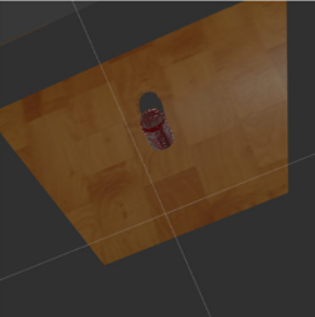
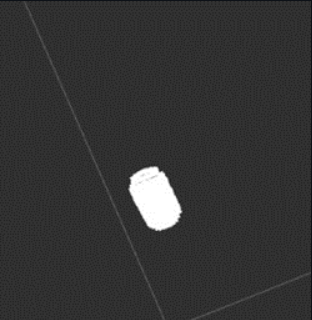
Left: Raw input point cloud. Right: Point cloud after RANSAC plane removal, isolating the target object.
2. Symmetry-Based Point Cloud Completion
- Evaluates multiple candidate symmetry planes for the object.
- Selects the optimal plane using a visibility scoring metric, accounting for occlusions introduced by the camera perspective.
- Uses the identified symmetry to reconstruct the incomplete side of the object’s point cloud.
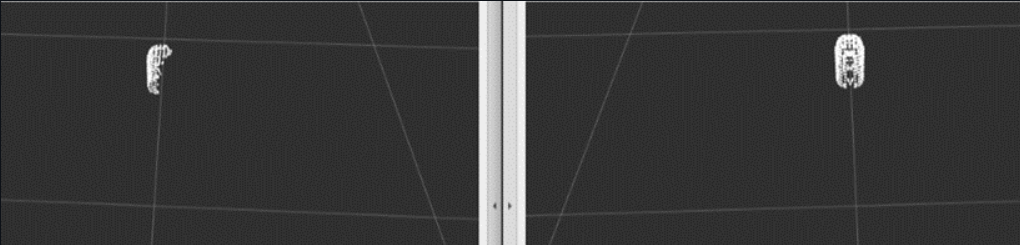
Symmetry-based point cloud completion — reconstructing occluded regions of the object.
3. Surface Normal Analysis
- Computes surface normal vectors at each point using local neighborhood analysis.
- Leverages KDTree spatial indexing for efficient nearest-neighbor queries across the point cloud.
4. Grasp Point Identification
- Identifies the first contact point nearest to the point cloud’s centroid.
- Selects a second contact point that minimizes the angle between the surface normals and the grasp vector, maximizing grasp stability.
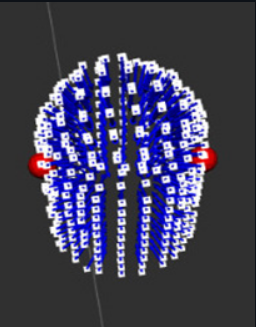
Identified optimal grasp contact points based on symmetry and surface normal analysis.
Results
The approach was demonstrated on:
- Cylindrical objects — beverage cans
- Spherical objects — cricket balls
Both object classes were grasped reliably, validating the method’s versatility across different geometric forms.
Key Takeaways
- Combines geometric symmetry detection with physics-based grasp stability principles.
- Computationally efficient — suitable for real-time robotic manipulation.
- No object-specific training or CAD models required.